

Part III: The Culture—Looking Back on What Defined G98 Red

This is part three is a series exploring the 2013 Eastside FC G98 Red national championship team. From the defining moment, to the people behind it, to the culture it helped shape, each part traces how one team came to influence everything that followed.
There are youth teams that win championships because they peak at the right moment, when talent, schedule, and circumstance briefly align in their favor. And then there are teams that win because something more durable had taken hold over time, something less visible in highlights or statistics, but unmistakable when the pressure arrived and the game began to tighten in on itself.
The G98 Red team faced ups and downs throughout that year, yet, by the end of that same journey, they stood as national champions, having navigated a path defined less by control than by resilience, continuity, and an unusual kind of cohesion that had been forming long before winning became the measure of success.
To understand what made that possible, it helps to start not with the final, or even the season itself, but with the way the group came into being.
In a landscape where so many teams struggle to stay together over time, this group held its core in place and grew stronger year after year. They were not assembled and reassembled, nor shaped by constant change, but instead built through continuity, shared experience, and a deep sense of trust that developed over seasons of working and competing together.
Instead, they accumulated. Players grew into roles alongside one another across years, moving through developmental stages together, learning not just the mechanics of the game but the rhythms of each other’s decisions, tendencies, and emotional responses under pressure. By the time they reached the point where results began to define their trajectory, they were no longer in the process of learning each other. That work had already been done quietly, in the background, through repetition and shared experience that predated the urgency of outcome.
At the center of that early formation was Michelle French, a former U.S. Women’s National Team player and current head coach of the University of Portland Women’s Soccer program, whose influence on the group extended far beyond tactical instruction or competitive structure.
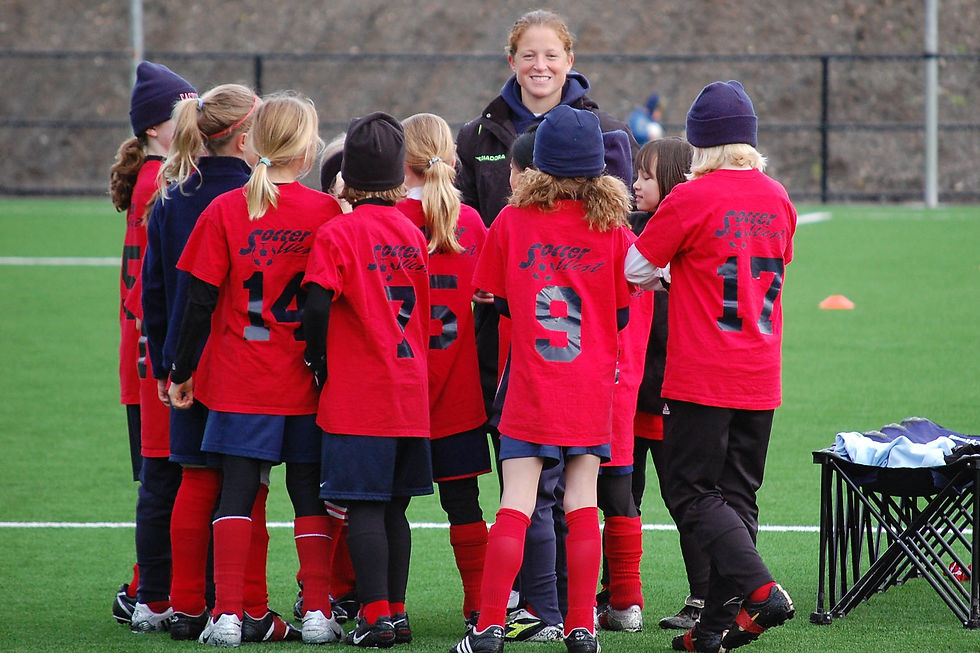
What she encountered in those early years with the team was not simply a collection of promising players, but something more unusual in high-performance youth environments: a group that remained genuinely connected to one another in a way that did not erode under the introduction of competition or roster additions. The energy within the team, as she later described it, was marked by an unusual consistency of joy, not as something separate from seriousness or ambition, but as a condition that seemed to coexist naturally with both.

“From day one with this core group of players, the amount of energy, excitement, and pure FUN they brought to every training session, every team bonding moment, and every game could be felt,” remembered French. “They possessed an undeniable, genuine joy when they were around each other off the field and that feeling naturally translated to their performance on the field. Prior to the current days of players moving from club to club, this particular group remained committed to each other, both in their growth on the field, and in their friendship off. The chemistry and culture developed over the years, between not only the young female athletes, but the parent group as well, proved to be the foundation that elevated the success of the team on the field.”
Training sessions carried a kind of momentum that did not require external motivation to sustain, and the relationships forming off the field were not distractions from performance but part of what stabilized it. In her reflection, the chemistry that developed between players—and perhaps just as importantly, between families—became a structural element of the team’s success, not an accessory to it. The group functioned not because it was insulated from pressure, but because its internal cohesion had been established before pressure fully arrived.
When French eventually left to join the U.S. national team coaching staff, the transition could have marked a fracture point in the team’s development. That is often how youth systems behave when a foundational figure exits: identity becomes unstable, continuity weakens, and performance begins to fluctuate as players adjust to new leadership and expectations. But in hindsight, that transition unfolded differently. The group did not reset. It did not fragment or reorient itself around a new identity. Instead, it absorbed the change within an already established framework.

Tom Bialek, Eastside FC’s current Director of Soccer, stepped into a team dynamic that already understood itself, and rather than reconstructing its foundation, he worked within it, refining rather than replacing what had already been built. What might have been a moment of disruption instead became a test of continuity, and the team, rather than losing shape, held it.
“I’m very proud of what the girls accomplished, and it all started with the work they put in and the existing belief in one another that grew from that commitment,” Bialek remembered. “They paid attention to the details, combined real talent with strong team unity, and earned every bit of success that came their way. At that level, you also need moments where the ball breaks your way—and they did—but that’s always part of what it takes to win a championship.”
The season that followed would ultimately define the group’s legacy, but it did not begin in a way that suggested clarity or control.
At the Washington State Championship, they advanced through group play without conceding a goal, a detail that in retrospect suggests dominance but at the time felt more like stability than separation. In the final, however, they encountered a match that resisted resolution. Regulation ended without a goal from either side, and the game moved into penalties, where they ultimately fell short. In many competitive environments, particularly at youth level, such a moment can function as a quiet endpoint, a loss that becomes a defining emotional reference point for a group, especially when pathways forward are uncertain. But in this case, the structure of the competition allowed for continuation through a wildcard entry, and with that, the story did not conclude but instead shifted shape. They were not eliminated, but they were also not yet redeemed. They were simply still in it, carrying forward without resolution.
What followed at Regionals, in retrospect, was less a surge in performance than a narrowing of focus. The games became tighter, the margins thinner, and the demands less about expression than control. They did not overwhelm opponents in a conventional sense, nor did they rely on moments of individual brilliance to separate themselves from the field.
Instead, they began to operate within constraints, learning how to absorb pressure without losing structure, how to stay connected when matches tilted toward uncertainty. In the regional final, against a team they had already drawn earlier in the competition, they produced their most decisive result of the tournament, winning 3–0 in a performance that felt less like a breakthrough than a confirmation of something that had been developing incrementally over time. It was not a reinvention of identity, but its clarification.
By the time they reached the national stage, that identity had fully settled into place. The group stage did not produce volatility or dramatic swings in form. Instead, it produced a pattern of controlled outcomes—wins, draws, narrow margins that accumulated rather than exploded. There was no sense of improvisation in how they approached the tournament.
Instead, there was a growing consistency in how they managed games that never fully opened, and in how they prevented opponents from dictating tempo even when matches remained close. They were not chasing momentum in the way teams often describe it, but rather sustaining a kind of emotional and tactical equilibrium that allowed them to remain intact across varying contexts.
By the time they reached the final, they were not adapting to something new. They were repeating something already proven under less intense conditions.

The championship match itself did not require reinvention. It unfolded in a way that reflected much of what had already defined the team’s season: an early goal that set structure, a second that extended control, and a late concession that reintroduced tension without undoing the underlying shape of the game. The final minutes were not marked by expansion or chaos, but by containment. The game closed at 2–1, a scoreline that captures very little of what had actually been required to reach that point. Because the significance of the result did not lie in the match alone, but in the accumulation of everything that preceded it—the years of shared development, the continuity through coaching transition, the capacity to remain connected when games narrowed and pressure increased.

In the years since, players have described the experience less in terms of trophies than in terms of relationships and identity.
Sophia Butterfield, who spent her career with the group as a winger, described it as a rare overlap of friendship and performance, where the boundaries between competition and daily life were often indistinguishable.

“Our team had a knack for fun as well,” Butterfield remembered. “I do not feel like I missed out on any part of my adolescence like some other athletes do who grew up in competitive travel sports. Always laughing, joking, hanging out all together-- we were just a group of best friends that were also really good at soccer. Our parents are largely to thank for the fun as well. They spent countless hours organizing creative activities to keep us off our phones and active on trips. We had our own version of the TV Show ‘The Amazing Race’ that our chaperones would set up and facilitate, got to go on all the rides at the Stratosphere in Vegas (Tom even bungee-jumped off the Stratosphere), and always found beach time in California of course. These examples are just the tip of the iceberg for the shenanigans that we would (responsibly) get into, all while keeping the focus of why we were on the trip, to win a dang soccer tournament.”
Cameron Tingey emphasized not only what the team achieved, but who it was achieved with, suggesting that the meaning of the season remained inseparable from the people involved.
“For ten years, Eastside FC was my constant. We grew not only as athletes, but as teammates, leaders, and lifelong friends,” Tingey recalled. “Through every high and low, these girls and our coaches were there—pushing me, supporting me, and celebrating life with me. I built grit, confidence, teamwork, and skill over the years—through every hard-fought battle on the field and through the unforgettable laughs, games, and rituals off it.”
“Winning nationals was unforgettable, but what mattered most was who I did it with. Eastside taught me what it means to be part of something bigger than yourself—to work hard not just for your own success, but for the people beside you. To call it just a sport, a game, or a team doesn’t come close to capturing the role it played in shaping who I am. They are my teammates, my family, and a part of me forever,” Tingey added.
Alexa Kirton, who played forward and midfield at the University of New Mexico before going on to a professional career in Iceland and later building a life in London working in sales, reflects on that G98 team not as a closed chapter, but as something still actively shaping the club today. For her, the meaning of that era lives on every time a new player pulls on the jersey.

“It’s been 13 years since we lifted that trophy, and nearly a decade since we last shared a field together, but that star on the crest means our legacy never really left,” Kirton said proudly. “Every player who looks down at their chest carries a piece of what we built.” That idea of inheritance is central to how she sees the program now: not just standards of performance, but a belief that greatness is achievable when hard work is matched with joy.
She remembers that group not only for what they won, but how they lived it—competing at a high level while genuinely loving the experience: every practice in the pouring Pacific Northwest rain, every game, every car ride. “We were family,” Kirton said. “That togetherness was our foundation.”
For Kirton, the current rebrand isn’t just cosmetic—it’s a passing of the torch. The crest carries a new generation now, and the star is there to inspire rather than simply commemorate. “Now it’s their turn,” she says. “Go earn that second one.”
JoJo Harber reflected on the team. “Having played on many teams throughout my career, there was something special about this team, which is a testimony to the camaraderie and bond we had. We deeply cared for each other on and off the field. We made soccer into what it was always meant to be: a sport we all loved and enjoyed, wrapped around memories we will cherish forever. From the pranks at practice and the pre-game rituals, to the tournament hydration games and carpool dances,” Harber recalled.

Harber continued, “"The national championship weekend felt different from the previous years, the moment we arrived at the tournament. In every game leading up to the finals, I looked around at every single girl on my team and saw a collective, undeniable determination to win it all. Before the championship game, we started with our pre-game superstition, blasting Eminem before getting out of the car to go to warm up. When the game began, everyone was locked, and we just knew this title was ours to take. And when the final whistle blew, that feeling was indescribable. Every single player had left absolutely everything on that field, and every family member and loved one was celebrating with us on the field. That's not something you forget."
More than a decade later, Kaylene Pang’s path from center back on the G98 Red national championship team to a career built around structure and problem-solving feels like a natural extension of how she played. After helping anchor Eastside FC’s back line, she went on to the University of Washington, where she continued her career as a defender while earning a Bachelor of Science in Mechanical Engineering. That combination—discipline on the field and precision in the classroom—has carried through into her professional life. Following graduation, she worked at Bain & Company in management consulting and now serves as a Senior Strategy Implementation Manager at Boston Medical Center, translating the same traits that once organized a defensive line into large-scale systems and strategy work.
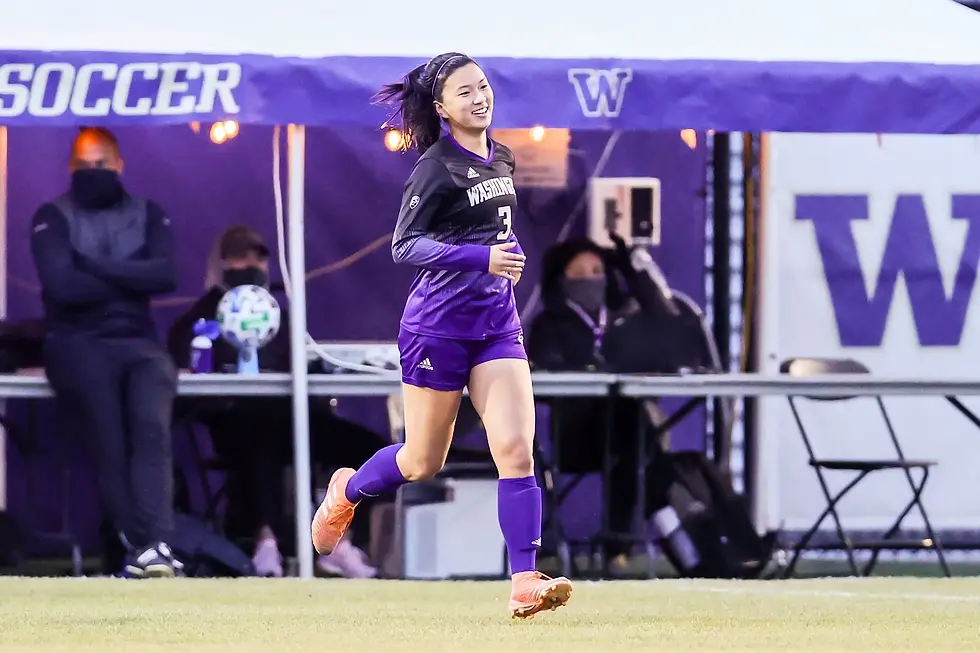
Other teammates from that championship group have followed similarly diverse but equally ambitious paths. Laura Roberts also went on to play at the University of Washington alongside Kaylene, spending four years as a defender in the same program before graduating and pursuing medicine, where she is now a medical student in Southern California.

Makaylie Moore took a different route but stayed deeply connected to the game, playing at BYU and appearing in the 2021 NCAA National Championship match. Today, she is an Assistant Coach at Salt Lake Community College while also serving as an Area Director and coach for Utah Avalanche, continuing to shape players in the same competitive environments she once starred in.

After her time at Eastside FC, Olivia Van der Jagt continued her development at the University of Washington, where she became a standout midfielder and earned All-Pac-12 honors. She was selected in the 2022 NWSL Draft by Seattle Reign FC, making an immediate impact in her rookie season. Known for her work rate and control in midfield, she helped the Reign capture the 2022 NWSL Shield. She later gained additional professional experience during a loan stint with Spokane Zephyr FC. Van der Jagt remains part of the growing group of Eastside FC alumni who have successfully reached the professional level.

That is ultimately what distinguishes this story from many others in youth sport. It is not simply that Eastside FC G98 Red won a national championship, but that they did so without sacrificing the conditions that made them recognizable to themselves. They did not become something else in order to succeed. They became more fully what they already were. And even now, years later, that distinction is what makes the story endure.
Those conditions are visible today within some of the club’s highest-performing teams, where you can see players who genuinely invest in one another, hold shared standards, and grow stronger through continuity rather than constant turnover. It’s not just about talent at any single moment, but about the way relationships deepen over time and translate into trust on the field, and that thread from G98 to now is one of the clearest signs that the environment continues to produce something meaningful.


Comments